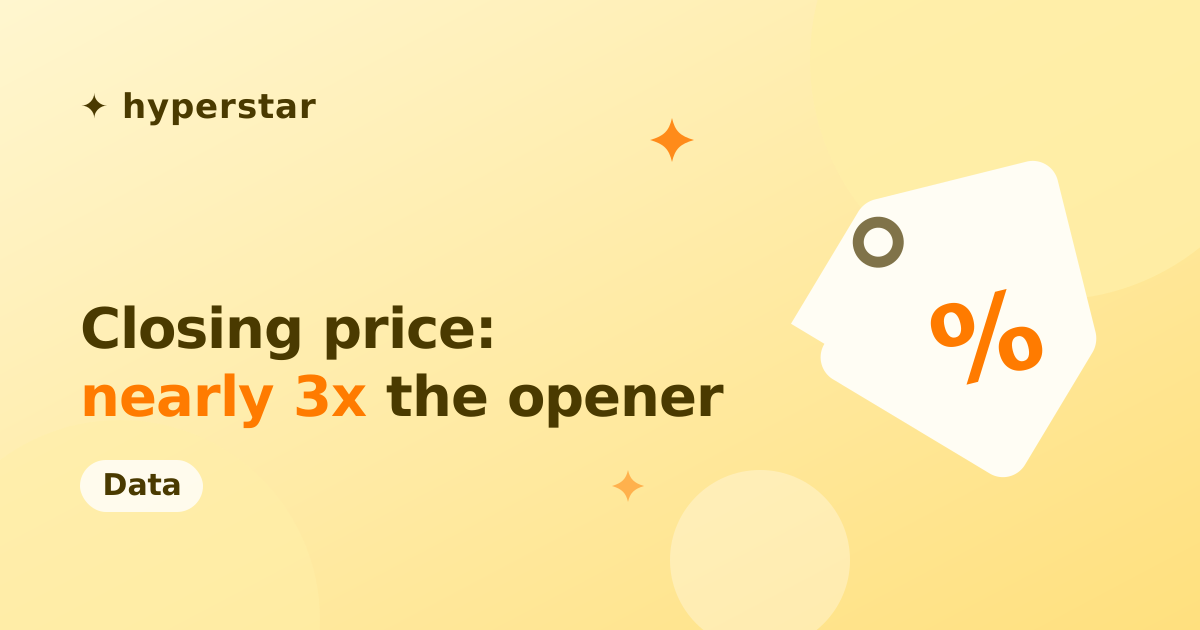
Data Net Influencer reported in late October 2026, compiled by Ames Create — an independent creative studio that negotiates brand deals on creators' behalf — shows brands opened negotiations for a single sponsored video at a median of $433, while the deals that actually closed landed at a median of $1,250, nearly three times higher. The figures come from 124 brand-creator negotiation conversations the studio logged between February 2024 and October 2026. If your team budgets a per-video line off the number your own outreach puts on the table first, this data says you're very likely building in a gap that gets blown through before the deal closes — not because the creator is overcharging, but because an opening offer and a closing price are two different numbers. Here's what the figures actually show, how much a single agency's own deal log should weigh in your planning, and what to check before you lock a per-video budget for next quarter.
What exactly does the data show?
Per Net Influencer's report, Ames Create's dataset puts the median brand opening offer for a single sponsored video at $433, against a median closing price of $1,250 — roughly 2.9x, rounded in the headline to "nearly 3x." The studio also compared its own numbers against published rate-guide figures: Modash and Karat's rate guides put sponsored Instagram Reel pricing at $15 to $35 per 1,000 views, while the brands' own effective pricing inside Ames Create's negotiated deals worked out to $7 to $10 per 1,000 views — below the low end of the published range. Separately, across 10 multi-month campaigns that closed, monthly pay ranged from $2,667 to $15,000, with a median of $6,750. None of these figures describe the industry as a whole; they describe one studio's own book of negotiated deals.
Why does the opening offer land so far under the closing price?
The more useful number in the report isn't the gap between the brand's offer and the final price — it's what the final price is close to. Per the reported negotiation pattern, deals that closed landed 11% to 33% below the creator's own initial quote, and brands' first numbers were typically described as "a fraction" of that quote. Read together, those two facts say the brand's opening offer didn't do much to pull the final number down — the deal settled much closer to what the creator asked for than to what the brand first proposed. That makes the $433 figure look less like a market price a brand believed it could get, and more like a negotiating anchor: a number set deliberately low to see how much room exists, not a number anyone expected to close at. The report doesn't state why brands open this low, so treat that as an observed pattern, not a confirmed motive — but the practical read is the same either way: lowballing the open rarely moves the close, it mostly adds negotiation rounds.
How much weight should a 9-to-10-deal sample carry?
Before you touch a budget line based on this, know what's actually behind the headline. The dataset is self-reported — pulled from Ames Create's own email and deal log, not independently audited — and while it spans 124 conversations overall, the specific opening-offer median rests on just 9 videos and the closing-price median on just 10 deals. Each published figure reportedly pools at least three deals from at least two different creators, which rules out one outlier creator skewing a single number, but it doesn't turn one agency's book of business into an industry benchmark. Treat this as a useful, recent data point to check your own assumptions against — not a rate card to adopt wholesale.
Are multi-month retainers priced the same way?
No — and mixing the two budget lines will scramble your math. The same report's 10 multi-month campaigns that closed paid $2,667 to $15,000 a month, with a median of $6,750. That's a materially different pricing structure from a one-off sponsored video, driven by different factors — ongoing availability, exclusivity, and a standing relationship rather than a single deliverable. If you're comparing a retainer quote against the $1,250 single-video median above, you're comparing two different products.
What should you check before you set next quarter's budget?
- Don't set your approved ceiling at your own opening-offer number. The data above suggests the gap between what you open with and what you'll likely pay can run close to 3x — build that headroom in before outreach starts, not mid-negotiation.
- Example: run your own numbers before you negotiate. If you budget 10 single-video deals at the reported opening-offer median ($433), that's $4,330 total. At the reported closing median ($1,250), the same 10 deals come to $12,500 — an example gap of roughly $8,170 between the number you might plan around and the number you might actually pay.
- Treat Ames Create's figures as one agency's own deal log, not an industry rate card. Check them against your own historical negotiation records before you change your internal budget bands.
- Keep multi-month retainer budgets on a separate line from single-video budgets. The $2,667–$15,000 monthly range above describes a different pricing structure, not a discount on the per-video number.
- Remember the published medians rest on 9–10 deals each. Don't treat them as a precise market price — treat them as a signal worth testing against your own deal history.
- Recheck this against updated reporting before you lock numbers. This is a single, recent data point from one studio's book of business — not a settled industry benchmark.
None of this budgeting math works without knowing, before you make an opening offer, what a given creator's content is actually likely to be worth to your sales — Get started.